


I’ve been saying this for years. Anker, eufy and soundcore are three of the strongest names in consumer tech, all owned by the same company, all doing really well, and all wandering around under separate branding for some reason. It never made sense to me. Anker is a massive, trusted name on its own. eufy is trusted for cameras and robot vacuums. soundcore has built real credibility in audio. Splitting a strong company into weaker, less recognisable pieces always felt like a mistake dressed up as strategy, and it looks like Anker has finally come around to the same conclusion.
Anker Innovations has announced that its five brands, Anker, eufy, soundcore, SOLIX and eufyMake, are being folded back into a single name: Anker. The change won’t happen overnight. New products will carry the unified branding first, existing product lines will transition gradually, and warranty and support stay exactly as they are. Alongside the rebrand, the company is opening its first standalone Anker store in Berlin and dropping a genuinely large wave of new hardware across audio, charging, smart home, robotics and home energy.
The rebrand is the headline, but there’s a lot to get through, so I’ll take the announcement in the order it’s likely to matter to you: why the unification makes sense, then the actual products landing in Ireland over the coming months.
Why splitting the brand up never made sense
Category brands make sense when you’re a small company trying to punch above your weight in a specific niche. eufy could go toe to toe with Ring and Arlo without dragging Anker’s charging reputation into it. soundcore could compete with Sony and Bose on its own terms. That logic worked for a while.

But the boundaries between those categories have basically dissolved. A power bank now needs the same on-device AI smarts as a pair of earbuds. A smart camera and a robot mower are both, functionally, home robotics. When soundcore quietly started rebranding to Anker Sound & Video in China back in April, it was a fairly clear signal that the company itself had noticed the same thing. Keeping five separate identities around one increasingly overlapping set of technology was just diluting the trust each one had built individually, rather than compounding it. One strong, recognisable name behind everything is the more obvious move, and I’m glad it’s actually happening rather than staying a rumour.
The new audio lineup, built around Anker’s own AI chip
Anker’s THUS chip, a neural-net compute-in-memory chip that runs AI processing directly on the device rather than in the cloud, first showed up back in May. It’s now the backbone of a full new audio range.
The AeroClip 2 and AeroClip 2 Pro are clip-on earbuds rather than the usual in-ear style, built around an open listening design with a 12mm driver, LDAC support and real-time AI translation. Anker claims the ergonomic shape fits 99% of ears, which is the kind of number I’d want to actually try before believing, but the call quality pitch, built on the THUS chip handling noise in real time, is the more interesting claim to test.
- AeroClip 2 will launch in September for €169.99 on Amazon.ie, with AeroClip 2 Pro becoming available in November, €229.99 on Amazon.ie.
The Space 2 Pro over-ear headphones bring the same call-quality tech to a more traditional shape, with 30 hours of battery life with noise cancellation on and 60 with it off. The Liberty Buds 2 are a standard in-ear pair with an 8-sensor array for calls and 9.2mm drivers for music.
- The Space 2 Pro arrive in September for €199.99 on Amazon.ie, along with the Liberty Buds 2 for €129.99 on Amazon.ie.
Sleep tech gets the biggest expansion. The Sleep 4 and Sleep 4 Pro build on Anker’s already popular sleep earbud line, with the Pro model adding heart rate and HRV tracking that feeds into what Anker calls BioSync, adjusting the audio in real time to try to actually get you to sleep rather than just playing a static white noise loop. The charging case has its own touchscreen, so you can set an alarm or change sounds without picking up your phone.
- Sleep 4 comes in October for €199.99 on Amazon.ie and the Sleep 4 Pro landing in November for €279.99 on Amazon.ie.
For anyone who won’t wear anything in their ears overnight, the SleepLab and SleepLab Pro are Anker’s first bedside sleep speakers. The Pro version uses 60GHz radar to track heart rate, breathing and sleep stages without any wearable at all, then adjusts the audio to match.
Charging gear that manages your battery instead of just filling it
Charging is where Anker actually started, and the three new products here are less about raw speed and more about not wrecking your battery in the process.
The MagGo Power Bank Pro 2 is a magnetic wireless power bank with a built-in cooling fan, which sounds like overkill until you remember how hot wireless charging gets a phone. Anker claims it stays under 36 degrees throughout a charge and gets an iPhone 17 Pro to 50% in 25 minutes.
- MagGo Power Bank Pro 2 lands this October for €119.99 on Amazon.ie.
The Laptop Charger Pro is the more interesting one on paper. It recognises the connected laptop and applies a dedicated charging curve with an 80% charge limit through what Anker calls Care Mode, aimed at slowing down the battery degradation that comes from constantly topping a laptop up to full. It claims over 40% better battery health over time, backed by monthly reports through a companion app. It’s not landing until Q1 2027 though, and pricing hasn’t been confirmed.
The MagStand Charging Station is a bedside hub that replaces the usual tangle of separate chargers with one 25-watt magnetic pad, a retractable cable and a hidden USB-C port, and it paces overnight charging so your phone finishes near your alarm rather than sitting at 100% for six hours.
- MagStand Charging Station launches in November for €99.99 on Amazon.ie.
Smart home and robotics
On the home side, the Video Doorbell S4 gets a proper 180-degree panoramic view to kill the usual doorbell blind spots, and the upcoming TrackLight Cam S1 pairs a 4K telephoto camera with an auto-tracking light that follows anyone approaching the house.
- The Video Doorbell S4 will be available from tomorrow for €329.99 on eufy.com/ie and Amazon.ie, with 15% off from 4th to 30th September. The TrackLight Cam S1 is coming in Q4 2026 on eufy.com/ie and Amazon.ie, with the final price to be confirmed.
The Robot Vacuum Omni E35 is aimed squarely at households with young kids, having earned TÜV certification as a “maternal and infant cleaning robot” for bacterial elimination and low noise. It pairs a self-cleaning roller mop with 35,000 Pa of suction.
- Robot Vacuum Omni E35 launches tomorrow for €1,099 on eufy.com/ie, Amazon.ie, Harvey Norman, DID Electrical, Euronics and Expert, with €100 off from 4th to 30th September.
The Robot Lawn Mower S2 Max is Anker’s first fully in-house mower, with no boundary wire or RTK base station needed, an extendable cutting arm for genuine edge-to-edge cutting, and enough grunt to handle slopes up to 38 degrees. It’s a serious spec sheet, but it’s not due until May 2027, so treat it as a preview rather than something to plan around. However, you can check out my review of the Anker’s E15 lawnmower.
Anker also teased MindBase, a local AI hub meant to tie devices across the newly unified brand together, handle AI processing on-site rather than in the cloud, and store household data locally rather than on a server somewhere. There’s no pricing, availability or firm product details yet, so it’s one to watch rather than one to get excited about just yet.
Home energy: two new batteries aimed at Irish and UK households
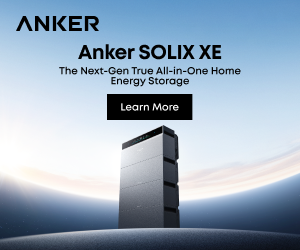
The SOLIX XE is Anker’s next look at all-in-one home energy storage, combining the inverter, battery and battery management system into a single unit rather than the usual separate boxes. Each unit holds 7kWh, expandable up to 126kWh across three units, with 15kW of solar input and a choice of 5kW, 6kW or 8kW output. The cells are rated for 10,000 charge cycles and support two charge cycles a day, which Anker says works out to roughly 14kWh of usable capacity per day from a single 7kWh unit. The built-in AI energy management system connects to over 870 European electricity suppliers and automatically times charging and discharging around the cheapest rates.
- SOLIX XE will be available from 18 September through authorised installers with the price to be confirmed
The SOLIX S2000 is the portable version, built around runtime rather than raw output. It offers 2kWh of capacity with 1,500W rated output, an idle draw of just 10W, and Anker says it’s independently verified by TÜV SÜD as having the industry’s highest runtime rating for a unit its size. It includes a built-in UPS with under-10ms switchover, which matters if you’re running anything that genuinely can’t lose power for even a second, like a router or a CPAP machine.
The TL;DR
The individual products here range from genuinely useful to still-just-a-teaser, and I’ll be covering several of them properly once they’re actually in hand. But the story that matters today is the brand move, and it’s the right call. Anker, eufy and soundcore were never weak names that needed hiding behind each other. They were strong names being asked to compete separately when they could have been compounding trust into one. Folding them back into Anker isn’t Anker admitting a mistake so much as it’s Anker catching up to what the products themselves had already become. The unification starts now, with the first products landing in Ireland from tomorrow.